

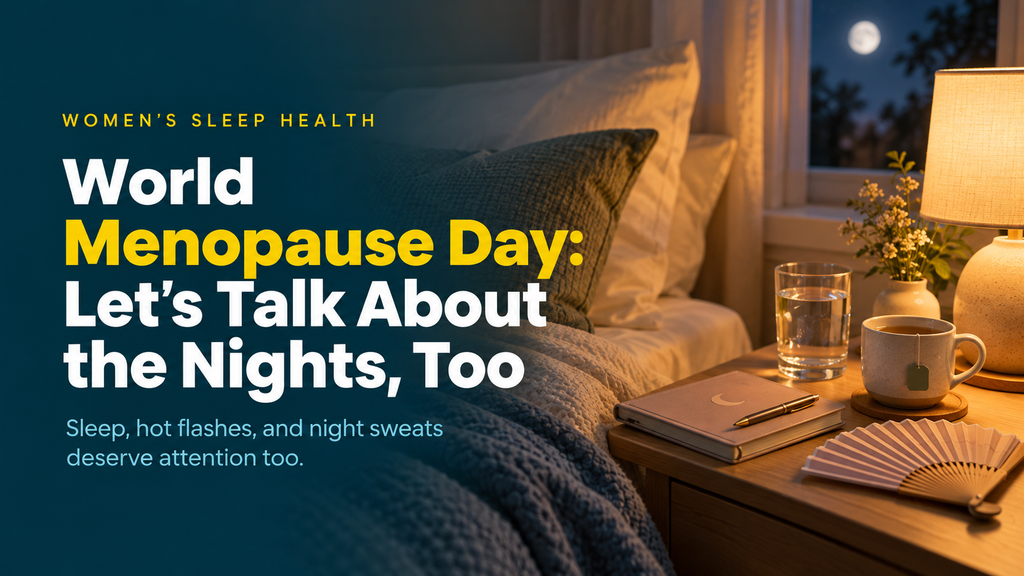
Because menopause symptoms don’t stop when you go to bed.
October 18 was World Menopause Day.
We often hear about hot flashes, mood changes and shifting hormones, but there is another part of menopause that deserves more attention: sleep.
And sleep problems are common. A 2024 meta-analysis of 37 studies involving more than 29,000 menopausal women found that about half experienced poor sleep quality.[1]
But here is the part we sometimes miss: not every sleep problem during menopause is caused by menopause.
Menopause and Sleep: Why Sleep Problems Happen and What Can Help
Why does sleep change?
The menopause transition can affect several things that influence sleep. Hot flashes and night sweats can wake you up. Changes in mood and stress can make it harder to settle at night. Some people start taking longer to fall asleep, waking more often or simply feeling that their sleep is not as restorative as it used to be.
Research from the Study of Women’s Health Across the Nation (SWAN) has followed sleep across the menopause transition. Sleep difficulties can change during this time, and vasomotor symptoms such as hot flashes and night sweats are strongly associated with sleep disruption. But sleep problems can also occur without them.[2,3]
When menopause and sleep symptoms overlap
This is where things can get a little complicated.
Fatigue, brain fog, mood changes, difficulty concentrating, frequent awakenings and feeling unrefreshed can happen during menopause. They can also overlap with symptoms of a sleep disorder.
One that can be easy to miss is Obstructive Sleep Apnea.
A Canadian study of 6,179 women aged 45 to 60 found that 14.6% of postmenopausal women screened positive for obstructive sleep apnea, compared with 10.4% of premenopausal and perimenopausal women.[4]
That does not mean menopause automatically causes sleep apnea. But new snoring, breathing pauses, waking gasping or choking, morning headaches or ongoing daytime fatigue should not automatically be written off as hormones either.
What can help?
There is no single menopause sleep fix because there is no single reason sleep changes. Pay attention to what is actually happening at night.
Those details can help identify what kind of support may actually help.
- If hot flashes and night sweats are waking you, start with your sleep environment. Keep your bedroom comfortably cool and choose breathable bedding or sleepwear that makes temperature changes easier to manage.
- Try to keep your wake time relatively consistent, even after a rough night. Regular daytime movement, natural light, and a calming wind-down routine can also support your sleep-wake rhythm.
- Are you struggling to fall asleep? Waking repeatedly? Waking because you are hot? Snoring for the first time? Sleeping for seven or eight hours but still waking exhausted?
When should you see a healthcare professional?
An occasional bad night is one thing. Sleep problems that persist, affect how you function during the day or come up with new symptoms are worth discussing with a healthcare professional.
Consider seeking further assessment if you are regularly struggling to fall or stay asleep, waking exhausted despite enough time in bed, experiencing frequent or severe night sweats, or noticing significant changes in your mood or daytime functioning.
New or worsening snoring, witnessed breathing pauses, waking gasping or choking, morning headaches and excessive daytime sleepiness can also be signs that something other than menopause may be affecting your sleep.
You do not need to wait until your sleep becomes unbearable to ask for help.
A more complete approach: Treatment options for menopause-related sleep issues
The right approach depends on why your sleep is being disrupted. Menopause does not happen in isolation, and neither does sleep.
- Naturopathic care
Sleep, stress, nutrition, lifestyle, mood and hormonal changes can all intersect during menopause.
Resolve’s sleep-focused naturopathic care is available virtually across Ontario and is guided by a licensed Naturopathic Doctor. This provides an opportunity to look at the broader picture and develop recommendations based on the individual rather than treating sleep as an isolated symptom.
Learn more about Naturopathic sleep care offered to our Ontario residents→ Enhanced Care Scheduler (ND) – Resolve Sleep
If you are outside of Ontario, take a look at our options: Enhanced Care Scheduler – Resolve Sleep
- CBT-I for persistent insomnia
If difficulty falling asleep or staying asleep has become persistent, Cognitive Behavioural Therapy for Insomnia (CBT-I) may help. CBT-I addresses the thoughts and behaviours that can keep chronic insomnia going and is strongly recommended by the American Academy of Sleep Medicine for adults with chronic insomnia.[5]
- Supplements and sleep support
Melatonin, Magnesium, and other sleep-support supplements often come up in conversations about menopause.
Supplements may have a role for some people, but what is appropriate depends on your symptoms, medications, health history and what is actually affecting your sleep.
Explore sleep-support supplements → Natural Health Supplements for Sleep & Wellness | Resolve Sleep Shop
What if it could be sleep apnea?
If snoring, breathing pauses, gasping, morning headaches, or daytime sleepiness are part of the picture, a sleep apnea assessment can help determine whether testing is appropriate.
Not sure which direction fits your symptoms? Resolve’s Solution Finder can help you explore sleep-health options based on what you are experiencing, including sleep apnea assessment and treatment, CBT-I, supplements and other sleep solutions.
Explore the Solution Finder →Sleep Solutions for Better Health – Resolve Sleep help.
Frequently Asked Questions
Sleep changes are common during the menopause transition, but that does not mean you simply have to live with them. Persistent sleep problems may have several contributing factors, including hot flashes and night sweats, insomnia, sleep apnea, stress, or other health concerns.
There usually is not one single cause. Hot flashes, night sweats, hormonal changes, mood, stress and other health factors can all contribute to disrupted sleep during the menopause transition. [2,3]
It can be both. Symptoms such as fatigue, brain fog, poor concentration, and disrupted sleep can overlap. In a large Canadian study, postmenopausal women were more likely to screen positive for obstructive sleep apnea than premenopausal and perimenopausal women.[4]
Screening positive is not the same as receiving an OSA diagnosis, but symptoms such as new snoring, breathing pauses, gasping, or persistent daytime sleepiness are worth investigating.
No. Night sweats are common during the menopause transition, but they are not the only possible reason for nighttime awakenings. Persistent or unexplained symptoms should be discussed with a healthcare professional.
Not necessarily. Supplements can have side effects and interact with medications or health conditions. Evidence also varies depending on the supplement, so individualized guidance can help determine whether one is appropriate.
It depends on the supplement and what is causing the sleep problem.[6] Supplements may have a role for some people, but they are not a substitute for identifying an underlying sleep problem.
The takeaway
Menopause can change your sleep, but poor sleep does not have to become your new normal. Pay attention to what has changed, ask questions, and seek support when you need it. Understanding what is keeping you awake can help you find the right next step.
This article shares general information about sleep and is not a substitute for personalized medical care. Naturopathic services are currently available virtually to patients in Ontario.
References
1. Jia Y, Zhou Z, Cao X. Prevalence of poor sleep quality during menopause: a meta-analysis. Sleep and Breathing. 2024
2. Kravitz HM, Joffe H. Sleep during the perimenopause: a SWAN story. Obstetrics and Gynecology Clinics of North America. 2011.
3. Kravitz HM, Janssen I, Bromberger JT, Matthews KA, Hall MH, Ruppert K, Joffe H. Sleep trajectories before and after the final menstrual period in the Study of Women’s Health Across the Nation (SWAN). Current Sleep Medicine Reports. 2017
4. Zolfaghari S, Yao C, Thompson C, et al. Effects of menopause on sleep quality and sleep disorders: Canadian Longitudinal Study on Aging. Menopause. 2020
5. Edinger JD, Arnedt JT, Bertisch SM, et al. Behavioral and psychological treatments for chronic insomnia disorder in adults: an American Academy of Sleep Medicine clinical practice guideline. Journal of Clinical Sleep Medicine. 2021.
6. Yi M, Wang S, Wu T, Zhang X, Jiang L, Fang X. Effects of exogenous melatonin on sleep quality and menopausal symptoms in menopausal women: a systematic review and meta-analysis of randomized controlled trials. Menopause. 2021